Showing posts with label Wi-Fi. Show all posts

Wednesday, 16 December 2015

Sundar Pichai Says Mumbai Central to Get Free Wi-Fi by January; 100 Stations by 2016-End

At the Google for India event in New Delhi on Wednesday, Google CEO Sundar Pichai talked about the company's plans for supporting the Digital India initiative. Among the announcements, one of the highlights was the confirmation that Google will be working with Indian Railways to bring free Wi-Fi to 400 train stations. This had already been announced, but the specific deadlines had not been given. Today, Pichai said that 100 stations will get Wi-Fi by the end of 2016, which 10 million people will use every day. The project will first go live in Mumbai Central in January 2016, he added.
Google is tying up with PSU RailTel to implement the Wi-Fi facilities on stations, using RailTel's fibre optic network backbone that connects the stations themselves.

Aside from this, Pichai also announced that Google is exploring ways to bring Project Loon to India. The idea behind the program is to beam an Internet signal via hot air balloons. It's worth pointing out that the Telecom Minister raised concerns about the idea - in a written response to the Rajya Sabha, Ravi Shankar Prasad wrote, "The proposed frequency band to be used in the Loon Project of Google is being used for cellular operations in India and it will lead to interference with cellular transmissions."
The Google CEO also mentioned a partnership with the Tata Trust - the two are rolling out bicycles to 1,000 villages across three states, to teach women about the Internet. The bicycles will be equipped with Internet connected devices, and the people riding them will be trained by Google to educate women about how they can benefit from the Internet.
Pichai, who was born in India, has earlier blogged about how he believes the Internet can impact India, and says that despite the huge growth that has taken place in terms of the reach of the Internet, there are still a billion people who are completely offline, and this must be addressed. The railways Wi-Fi program will bring many of these people online, Pichai believes, and on the blog, he has also promised that the connections will be fast - "many times faster than what most people in India have access to today" - so it can be used for anything from downloading a book or a game for your journey, watching a video, or researching your destination.
Download the Gadgets 360 app for Android and iOS to stay up to date with the latest tech news, product reviews, and exclusive deals on the popular mobiles.


Saturday, 5 December 2015

Why Are Indian Telcos Focusing On Failed WiFi Strategy

wifi


A strange phenomenon is taking place in China. Contrary to the global trend, Chinese telcos are unwinding their WiFi deployments. The three service providers, China Telecom, China Unicom and China Mobile have decommissioned 87,000 WiFi access points this year. While WiFi is shrinking telcos added 680,000 2G, 3G or 4G base stations in the country.
On the other hand, there has been a marked increase in WiFi deployments in India. WiFi hotspots are emerging as an important and critical part of the mobile data revolution in the country. As of now India has a little more 30,000 WiFi hotspots in the country but this is likely to increase dramatically with both the telcos and the government focusing on it.

On the other hand, there has been a marked increase in WiFi deployments in India. WiFi hotspots are emerging as an important and critical part of the mobile data revolution in the country. As of now India has a little more 30,000 WiFi hotspots in the country but this is likely to increase dramatically with both the telcos and the government focusing on it.

While Vodafone and Bharti Airtel have together formed a company, Firefly to provide public WiFi focus on Government WiFi business, Reliance Jio is also setting up WiFi hotspots in all the major cities in the country. Firefly was in news recently for trying to raise foreign funding. BSNL has already installed more than 300 hotspots in 25 cities and hopes to increase this number to 1,000 by the end of the current financial year. Besides companies like Ozone are continuously adding newer WiFi hotspots.
Not just the telcos who are setting up their own WiFi networks in the country, the Government is also launching a number of initiatives to increase WiFi deployment in the country. A case in point is Indian Railways, which has recently announced that it would provide free WiFi to its passengers. Further, providing free WiFi was an important part of Delhi Government’s election campaign. The Central Government’s programs like Smart Cities and Digital India are also likely to push WiFi deployment in the country.
The situation in India now is somewhat similar to what was in China a few years back. The Chinese telcos started focusing on WiFi around 2011-12 to meet the increasing data demand. There was no 4G network at the time to meet the consumer needs for data services. Indian landscape is similar in the sense that the adoption of smartphone is growing in the country, which is fuelling the demand for mobile data. The telcos launched 3G about five years back and 4G about two years back but limited spectrum means that data offloading through WiFi is an important part of their network strategy. As networks become congested with growing data traffic, WiFi would be required to take some load.

However, could this be a case of flawed logic, especially if one considers the latest move of the Chinese telcos of decommissioning WiFi hotspots? Why is it that Indian telcos are investing in a technology, which is being abandoned by other countries?

A key reason for Chinese telcos to stop WiFi deployments is that they were unable to monetize it. While nearly 70% of data traffic was carried over WiFi, it was not even contributing 3% of the telco’s data revenues. This is the crux of the problem with WiFi and sooner or later Indian telcos would need to face the facts. WiFi is not a revenue generator and Indian telcos would ultimately need to for a dense 3G/4G network to garner maximum return of investment in mobile data.

The Chinese telcos have realized that WiFi needs to be used strategically for data offload but it is not a substitute for network expansion and modernization. It is time Indian service providers learn from their Chinese counterparts that WiFi is unlikely to lead to a substantial revenue enhancement.

Tuesday, 1 December 2015

Li-Fi Probably Won’t Be The New Wi-Fi For Most People

Long restricted to the academic domain, Li-Fi, a light-based data delivery method is suddenly getting all sorts of attention. An Estonian startup Velmenni recently tested an commercial implementation and found it to be superior to Wi-Fi in almost every way – except as something you and I will probably ever use.
Velmenni’s technology, called Jungru, uses an LED bulb and transmits data at gigabit speed. It has a theoretical speed of 224 gigabytes per second, the BBC reported. While the Jungru product is commercially viable, it is still based on what seems to be a laboratory-grade MATLAB and Simulink setup paired with photodiodes as opposed to a final product which must transmit data in real world environments full of light pollution and other variables.

University of Edinburgh Professor Harald Hass first demonstrated Li-Fi as a part of the D-light project at the school’s Institute for Digital Communications back in 2010. He gave a 2012 TED Global talk about it but but despite several companies being interested enough to start a Li-Fi consortium, the technology is still not a commercial contender.
LTE-WiFi-LiFi-House-Illustration
The technology uses protocols similar to the RF-band 802.11 protocols, with additional standards to eliminate the impacts of interference and impacts of ambient lighting. Despite this, however, the technology cannot be deployed in outdoors in sunlight or in other odd conditions.
While Li-Fi does come with the advantage of not interfering with radio signals, a lot of the benefits are overpowered by the simple fact that visible light cannot travel through walls, an essential factor which gives old-school Wi-Fi a huge advantage. This line-of-sight limitation does make the system more secure and gives better control over emissions, but it’s unclear what the minimum distance for signal reception would be if clear line-of-sight is achieved. With that in mind, it is easy to imagine the signal being intercepted by someone with a telephoto lens and an optical sensor tuned appropriately. While Li-Fi was touted as a possible channel for wireless communications on airplanes, widespread adoption of onboard Wi-Fi on most US airlines makes this use case less and less pertinent.
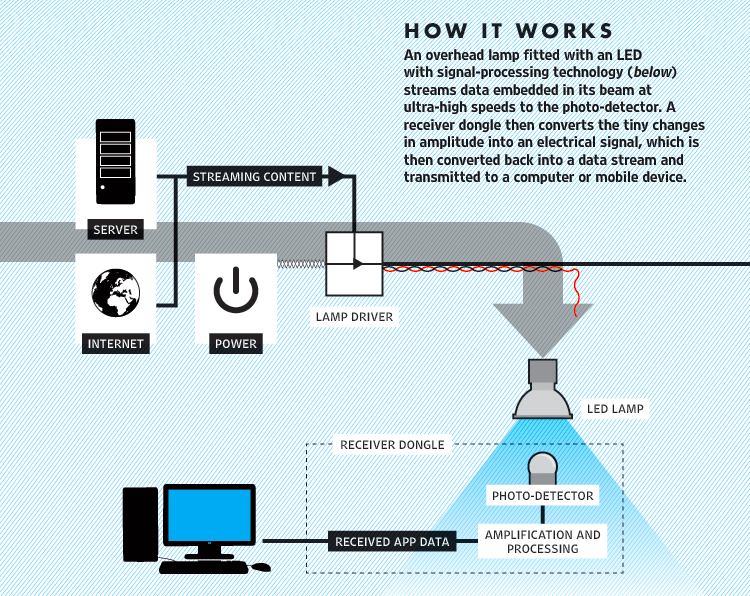
How_VLC_works
LED lightbulbs that use the technology don’t appear visually different – information is encoded in pulses of light that are small and rapid enough perturbations to be undetectable to the naked eye. While it’s attractive to envision a network of connected lightbulbs all being used to transmit data between nodes, it’s not clear if the benefits of faster wireless communication will outweigh the costs of constantly-on LED lights, as well as the cost of optical detectors requiring clear line-of-sight.

There certainly is room for Li-Fi and other visible light-based communication systems to grow in niche areas, but router manufacturers can rest easy for a while. Wi-Fi isn’t going anywhere soon, and neither is that router you bought on Black Friday and offers “piddly” 1300 mbps speeds with all the benefits of RF.


Tuesday, 3 November 2015

Worldwide VoLTE connections to reach 2 billion by 2020: Juniper Research

The number of VoLTE (Voice over LTE) connections is likely to reach 2 billion by 2020, increasing from an estimated 123 million in 2015, driven by new roll-outs by telecom operators worldwide, a new study from Juniper Research said.
mobile-using
The marked improvement in voice quality enabled by VoLTE is likely to spur increased adoption of the technology, the study added.

By 2020, VoLTE services will account for over $100 billion in annual service revenue, the study said. It also estimated that Far East & China will account for over 50% of the global VoLTE connections by 2020. The research, found that direct revenues from VoLTE will be limited at first, with increased availability of compatible handsets driving adoption of the technology.
Network operators will initially focus on experience and quality of service, rather than monetisation, with failure to deliver a high quality offering at the outset potentially resulting in churn to rival operators, the study said. Telecom operators, competing on quality of service, are also investing in Wi-Fi calling (VoWi-Fi), which is aimed at tackling the internal coverage issue. Globally, telcos are launching the service to add value for the customers with little investment, where VoLTE is focused on operator network efficiency.
In order to remain competitive, operators will also need to ensure that their communications offerings match those of leading OTT providers, the study suggested, citing the example of Facebook Messenger, which recently launched free HD (High Definition) VoIP call services over cellular and Wi-Fi networks. With this in mind, the study argued that an operator HD Voice service proposition would be a critical element.
HD voice adoption has been steadily rising since 2009, with over 130 operators worldwide offering Mobile HD Voice.

Juniper Research expects the number of capable devices to grow to over 1.3 billion by 2020, driven by manufacturer adoption and operator capability.