Showing posts with label BBC News. Show all posts

Tuesday, 29 December 2015

ISIS Ruling Aims To Settle Who Can Have Sex With Female Slaves


 ISIS theologians have issued an extremely detailed ruling on when "owners" of women enslaved by the extremist group can have sex with them, in an apparent bid to curb what they called violations in the treatment of captured females.
ISIS Ruling Aims To Settle Who Can Have Sex With Female Slaves
The ruling or fatwa has the force of law and appears to go beyond the ISIS's previous known utterances on the subject, a leading ISIS scholar said. It sheds new light on how the group is trying to reinterpret centuries-old teachings to justify the sexual slavery of women in the swaths of Syria and Iraq it controls.

To read the fatwa click here: http://graphics.thomsonreuters.com/doc/slaves_fatwa.pdf

The fatwa was among a huge trove of documents captured by US Special Operations Forces during a raid targeting a top Islamic State official in Syria in May. Reuters has reviewed some of the documents, which have not been previously published.

Among the religious rulings are bans on a father and son having sex with the same female slave; and the owner of a mother and daughter having sex with both. Joint owners of a female captive are similarly enjoined from intercourse because she is viewed as "part of a joint ownership."

The United Nations and human rights groups have accused the ISIS of the systematic abduction and rape of thousands of women and girls as young as 12, especially members of the Yazidi minority in northern Iraq. Many have been given to fighters as a reward or sold as sex slaves.

Far from trying to conceal the practice, ISIS has boasted about it and established a department of "war spoils" to manage slavery. Reuters reported on the existence of the department on Monday.

In an April report, Human Rights Watch interviewed 20 female escapees who recounted how ISIS  fighters separated young women and girls from men and boys and older women. They were moved "in an organized and methodical fashion to various places in Iraq and Syria." They were then sold or given as gifts and repeatedly raped or subjected to sexual violence.

Dos And Don'ts

Fatwa No. 64, dated Jan. 29, 2015, and issued by ISIS's Committee of Research and Fatwas, appears to codify sexual relations between ISIS fighters and their female captives for the first time, going further than a pamphlet issued by the group in 2014 on how to treat slaves.

The fatwa starts with a question: "Some of the brothers have committed violations in the matter of the treatment of the female slaves. These violations are not permitted by Sharia law because these rules have not been dealt with in ages. Are there any warnings pertaining to this matter?"

It then lists 15 injunctions, which in some instances go into explicit detail. For example:

"If the owner of a female captive, who has a daughter suitable for intercourse, has sexual relations with the latter, he is not permitted to have intercourse with her mother and she is permanently off limits to him. Should he have intercourse with her mother then he is not permitted to have intercourse with her daughter and she is to be off limits to him."

ISIS's sexual exploitation of female captives has been well documented, but a leading ISIS expert at Princeton University, Cole Bunzel, who has reviewed many of the group's writings, said the fatwa went beyond what has previously been published by the militants on how to treat female slaves.

"It reveals the actual concerns of IS slave owners," he said in an email.

Still, he cautioned that not "everything dealt with in the fatwa is indicative of a relevant violation. It doesn't mean father and son were necessarily sharing a girl. They're at least being 'warned' not to. But I bet some of these violations were being committed."

The fatwa also instructs owners of female slaves to "show compassion towards her, be kind to her, not humiliate her, and not assign her work she is unable to perform." An owner should also not sell her to an individual whom he knows will mistreat her.

Professor Abdel Fattah Alawari, dean of Islamic Theology at Al-Azhar University, a 1,000-year-old Egyptian centre for Islamic learning, said ISIS "has nothing to do with Islam" and was deliberately misreading centuries-old verses and sayings that were originally designed to end, rather than encourage, slavery.

"Islam preaches freedom to slaves, not slavery. Slavery was the status quo when Islam came around," he said. "Judaism, Christianity, Greek, Roman, and Persian civilizations all practiced it and took the females of their enemies as sex slaves. So Islam found this abhorrent practice and worked to gradually remove it."

In September 2014 more than 120 Islamic scholars from around the world issued an open letter to ISIS leader Abu Bakr al-Baghdadi refuting the group's religious arguments to justify many of its actions. The scholars noted that the "reintroduction of slavery is forbidden in Islam."


Thursday, 24 December 2015

Hyatt Is Latest Hotel Brand Hacked After Finding Malware On Its Payment System


Hyatt, the global hotel chain with 627 properties across more than 50 countries, is the latest in its industry to suffer a cyber security attack.

In an announcement devoid of specific information or details, the company revealed that it “recently identified malware on computers that operate the payment processing systems for Hyatt-managed locations.” Upon that discovery, it said, it began an investigation with third-party security experts that remains ongoing.
Hyatt didn’t say how many of its locations were affected, how exactly customer data might be compromised, nor how many customers may be impacted. It did say, though, that it has created a dedicated webpage where it will post updates from the investigation — that’s hyatt.com/protectingourcustomers.
Hyatt is just the latest hotelier to get hit by such an attack. Hilton, Starwood andMandarin Oriental are among the others to have been hacked this year alone.


Wednesday, 16 December 2015

Facebook Makes Changes To Its Real Name Policy Enforcement Process

After over a year’s worth of controversy around Facebook’s real names policy, Facebook has announced a couple of changes to its process in order to better serve all of its members, including those in the LGBTQ community.
Last October, Facebook promised it would make changes to its real name policy after a number of false account flagging incidents led to the suspension of LGBTQ members’ pages. Facebook requires people to use the names their friends and family know them by. For many drag performers, for example, their drag names are the names people know them by, but that didn’t prevent the suspension of their accounts.
While Facebook is not getting rid of its real names policy, it is starting to test new tools to improve the policy in order for it to work better “for everyone, especially for communities who are marginalized or face discrimination,” Facebook VP of Global Operations Justin Osofsky and Product Manager Todd Gage wrote on Facebook’s blog.

For one, Facebook’s new reporting process requires people to provide more information and context around why they’re reporting that name in the first place. Before, reporting a potentially fake name was as easy as the click of a button.
facebook real name
Secondly, Facebook is testing a new tool for people to defend and verify their name if someone else flags it. So, if your account gets flagged, even though you’re using your drag name, or are using a different name in order to protect your privacy out of fear of abuse, harassment or stalking, you’ll have a week to be able to describe your situation before Facebook suspends your account.
Screen Shot 2015-12-15 at 10.57.04 AM
“SF Pride is committed to our diverse community and is encouraged by the positive steps Facebook has both taken, and continues to work on, in addressing the reporting tools associated with their Authentic Names policy,” George Ridgely, Jr., executive director of SFPride, told TechCrunch in a statement. “We appreciate all of the engaged community leaders and Facebook for their contributions in this effort. It has been our priority to work closely with all parties to facilitate ongoing working-group meetings, as well as a forum that will bring together members of the community and Facebook to discuss these changes.”

Facebook has also received criticism around requiring people to provide forms of legal identification, which don’t always reflect someone’s preferred name.
Facebook has since expanded the options and documents that people can use to verify their name, and early next year, Facebook will look at ways to “reduce the number of people who have to go through an ID verification experience, while preserving the safety of other people on the site. We will also continue to work on making the experience itself more compassionate and easier to navigate.”


Saturday, 5 December 2015

Stone Temple Pilots’ Scott Weiland Dies at 48, Says Guitarist

Scott Weiland dead Stone Temple Pilots

Scott Weiland, the ex-frontman of Stone Temple Pilots and Velvet Revolver who battled substance abuse over the years, was found dead on Thursday. He was 48.
Jane’s Addiction guitarist Dave Navarro first reported the news on Twitter. “Just learned our friend Scott Weiland has died. So gutted, I am thinking of his family tonight,” Navarro wrote.
Weiland was found unresponsive on his tour bus in Minnesota, where he and his current band The Wildabouts were scheduled to perform at the Medina Ballroom, but the show was cancelled, according to TMZ.
It’s unknown what caused the singer’s death.

Weiland, who battled heroin and cocaine addiction over the years, was known for his flamboyant and unpredictable persona onstage.
Wielding a megaphone alongside his bandmates for sound effect, the fiery-haired frontman led the Southern California-based Stone Temple Pilots for two decades.
Also known as “STP” by their fans, the quartet first broke out in 1992 with hit single “Creep” before going on to become one of the most popular rock bands of the 1990s and 2000s with power ballads like “Plush,” “Big Empty” and “Interstate Love Song.”
Their music still plays in heavy rotation on alternative rock stations alongside ’90s grunge acts Nirvana, Soundgarden and Pearl Jam.
But it was Weiland’s rock star ways that often got him in trouble offstage.
After spending five months in prison for possession of heroin in 1998, he was later charged with domestic abuse for assaulting his wife.
In 2008, he checked into rehab after being arrested for a DUI and once, after a fight with his wife, leapt from a moving car to score heroin.
“People have this misconception about me,” he said in an interview with USA Today in 2011. “OK, I struggled with heroin and cocaine and I was a big rock star. But music is not what defines me. I’m a brother, a father, a son.”
Weiland later split from Stone Temple Pilots and formed supergroup Velvet Revolver with ex-Guns N’ Roses rockers Slash and Duff McKagan, and Matt Sorum. The band eventually split up, again because of Weiland’s substance abuse.
“I’m still on the verge all the time,” he said of his fight to remain sober. “My brother passed away [from a drug overdose in 2007], and that’s something that will always stay with me.”
In 2008, Weiland reunited with STP for the last time before leaving the band again and embarking on a solo career. But not, of course, without Weiland storming off in dramatic fashion.
After ex-members of Stone Temple Pilots sued the two-time Grammy-winner in 2013 for playing their material during his solo shows (STP was later fronted by Linkin Park singer Chester Bennington), Weiland countersued, calling his ex-bandmates’ claims “ridiculous.”
The group eventually reached a settlement out of court.
“I apologize to those fans out there who are, feel like they’re caught in the middle of it,” he said at the time. “‘Cause I sure feel like I’m caught in the middle of it emotionally, and all I want to do is play music.”

Known for his baritone vocal style, Weiland has also performed with the remaining members of The Doors for a VH1 “Storytellers” special.
He is survived by his two children, Noah and Lucy.


Tuesday, 1 December 2015

Li-Fi Probably Won’t Be The New Wi-Fi For Most People

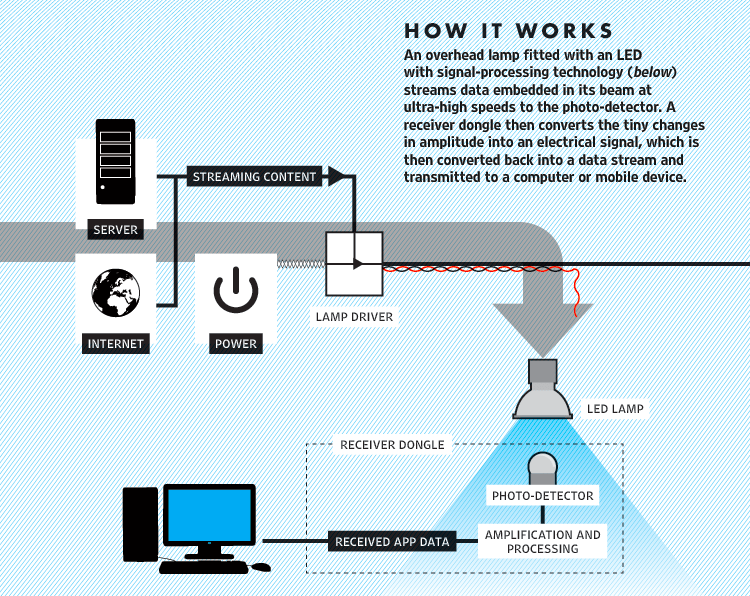
Long restricted to the academic domain, Li-Fi, a light-based data delivery method is suddenly getting all sorts of attention. An Estonian startup Velmenni recently tested an commercial implementation and found it to be superior to Wi-Fi in almost every way – except as something you and I will probably ever use.
Velmenni’s technology, called Jungru, uses an LED bulb and transmits data at gigabit speed. It has a theoretical speed of 224 gigabytes per second, the BBC reported. While the Jungru product is commercially viable, it is still based on what seems to be a laboratory-grade MATLAB and Simulink setup paired with photodiodes as opposed to a final product which must transmit data in real world environments full of light pollution and other variables.

University of Edinburgh Professor Harald Hass first demonstrated Li-Fi as a part of the D-light project at the school’s Institute for Digital Communications back in 2010. He gave a 2012 TED Global talk about it but but despite several companies being interested enough to start a Li-Fi consortium, the technology is still not a commercial contender.
LTE-WiFi-LiFi-House-Illustration
The technology uses protocols similar to the RF-band 802.11 protocols, with additional standards to eliminate the impacts of interference and impacts of ambient lighting. Despite this, however, the technology cannot be deployed in outdoors in sunlight or in other odd conditions.
While Li-Fi does come with the advantage of not interfering with radio signals, a lot of the benefits are overpowered by the simple fact that visible light cannot travel through walls, an essential factor which gives old-school Wi-Fi a huge advantage. This line-of-sight limitation does make the system more secure and gives better control over emissions, but it’s unclear what the minimum distance for signal reception would be if clear line-of-sight is achieved. With that in mind, it is easy to imagine the signal being intercepted by someone with a telephoto lens and an optical sensor tuned appropriately. While Li-Fi was touted as a possible channel for wireless communications on airplanes, widespread adoption of onboard Wi-Fi on most US airlines makes this use case less and less pertinent.
How_VLC_works
LED lightbulbs that use the technology don’t appear visually different – information is encoded in pulses of light that are small and rapid enough perturbations to be undetectable to the naked eye. While it’s attractive to envision a network of connected lightbulbs all being used to transmit data between nodes, it’s not clear if the benefits of faster wireless communication will outweigh the costs of constantly-on LED lights, as well as the cost of optical detectors requiring clear line-of-sight.

There certainly is room for Li-Fi and other visible light-based communication systems to grow in niche areas, but router manufacturers can rest easy for a while. Wi-Fi isn’t going anywhere soon, and neither is that router you bought on Black Friday and offers “piddly” 1300 mbps speeds with all the benefits of RF.


Thursday, 26 November 2015

How To Create An Account In Google Analytics

Google Analytics has become very much popular among the businesses that are on the look for tracking the traffic coming towards their website. It also helps them analyze how their website is performing among the website visitors. Thus this tool allows website owners to understand whether their website is providing the best experience for the website visitors or not.
Here is how an account can be created in Google Analytics.
Navigating to Google Analytics Website
  • Type Google.com/analytics/ in the browser
  • Click button denoted as 'Access Analytics'
  • A new web page will be displayed that consists of a brief introduction of how the Analytics works
  • Select the 'Sign Up' button for creating an account
  • Users can either sign up with their own personal Google Account or can create a new Google account specifically for tracking the analytics data which users do not want to mix up with the personal Google account

Website or mobile app tracking
Navigate towards the top of the page and choose buttons that help you choose among either a website tracking or mobile app tracking.
Add account information
Users will have to provide some basic information to Google as a means to create a Google Analytics account.
These are the basic information that has to be provided.
  • An account name has to be entered
  • Navigate towards the 'Setting up your property' option and enter the website name and URL or app name
  • Select the industry that suits your website and the business that you are dealing with and also choose the time zone
Additional Details
Other details that has to be included in creating an account include,
  • Choose among the four data sharing options that can be enabled as well as disabled as per the user requirements
  • Users will have to navigate towards an admin page where in users can get the tracking ID for their website or mobile app
  • The implementation and changes in the analytics tags can be performed much easily using the Google Tag Manager website
  • An account can be then created and a container can be added
Here is how a tag can be inserted within the websites using Google Analytics and help the website owners to start monitoring the results regarding how the website is performing among the site visitors.
Tag insertion in websites
  • When a container is created, a tag would be displayed which has to be copied and has to be inserted in each of the web pages that needs to be tracked
  • The source code will have to be opened in order to insert the tags
  • The copied code can be then placed right below the opening <body> tag
  • Navigate to the configuration page of the container and click the 'Add a new tag' link
  • Choose 'Google Analytics' from the product list
  • The tracking ID then has to be copied and pasted from the Google Analytics Admin page
  • Choose a Trigger for the tag
  • Click the 'Save Tag' button
  • Click 'Publish Now' to send the tag towards website and activate it

You will receive analytic reports after 24 hours and thereby can start monitoring the results


Article Source: http://EzineArticles.com/9147679


Saturday, 21 November 2015

Voter Is Tinder For Politics

As we approach election season the average person is probably confused by the plethora of candidates. Should you vote Trump? Hillary? Dr. Fantasmus the Libertarian Cyborg? Voter can probably tell you.
This app is basically a swipe left/swipe right interface for political leanings. It asks you questions about policy and then recommends a candidate based on who you should vote for. Do you support gun control? Dance classes in public schools? There’s probably a candidate for you.
Ultimately, said founder Hunter Scarborough, the system will allow users to submit their own votes to aggregated polls, a feature that will allow for more interesting and precise information for voters and politicians.


The service has 24,000 users and the company is raising capital.

“The platform we developed only recently became possible. Thanks to new open data initiatives, we now have access to up-to-the-minute political data,” said Scarborough. “This allows us to take an unbiased numbers-based approach that other political tools lack. To ensure the highest level of accuracy, we hold politicians accountable to their actions, analyzing candidates’ voting records, public agenda, personal views, speeches, and more.”

Voter is aimed at millennials who are political active. It’s basically a way to get up to speed on various candidates in a few seconds, a valuable proposition in this era of always-on news.
“Voter gives you a fast and fun way to become reliably politically informed,” said Scarborough. Sadly swiping left or right on a particular candidate doesn’t get you a date with them, although Trogdor the Undestroyable, mayoral candidate for the Darkest Core of Deathton (near Scranton) might be a cool dude to hang out with over a beer.


Tuesday, 17 November 2015

Hacking Collective Anonymous Declares Total War On ISIS Following Paris Terror Attacks

The hacking group Anonymous on Sunday declared “total war” against the Islamic State, the terror organization that claimed responsibility for the attacks on Friday that killed 132 Parisians.
Anonymous also posted a video, confirming the message was in response to the events in Paris.
According to the same Twitter account, the group began taking down websites associated with ISIS this morning.

Anonymous also retweeted a link to the following message from the hacktivist group Binary Sec:
“We as a collective will bring an end to your reign of terror. We will no longer turn a blind eye to your cruel and inhumane acts of terrorism towards all other religions that are not Islam. We’ve watched you behead innocent people, kidnap and murder children, and then launch terrorist attacks in France. This will NOT BE TOLERATED ANY LONGER. We here at BinarySec live for the sole purpose of bringing down All ISIS Propaganda ONE website and/or person at a time. ISIS… Your Jihad is coming to an abrupt end . We here at BinarySec will be one of the driving forces to your end and that’s a promise. ISIS… The War Is On.”
This is not the first time that Anonymous has taken on ISIS. Foreign Policy Magazine reports that the conflict between hackers that identify with Anonymous and ISIS has waged online for more than a year. A tipping point that forced many hackers to join the cause were the attacks on the Charlie Hebdo newspaper and kosher market in Paris earlier this year.
According to the FP report from last week, hackers have taken 149 Islamic State-linked websites offline and flagged roughly 101,000 Twitter accounts and 5,900 propaganda videos.

The remaining question is whether or not these hackers aiming to achieve social good are helping or harming state-driven attempts to take out the terror group. Technology companies have said in the past that government intelligence agencies ask them not to take down ISIS-related content because, when using the legal avenues at hand, they are able to more effectively track these groups.


Muslim TV host explains how to take a stand against ISIS

The self-proclaimed Islamic State is weak because it relies on fear, Australian TV host Waleed Aly said Monday in a plea for unity in the wake of attacks in Paris that left at least 129 people dead and hundreds more injured.
In a passionate segment for The Project that has been widely shared on social media, Aly called the terrorist organization known as ISIS, or ISIL, a weak group that would be "crushed" if it ever faced a "proper army." Rather than real power, he added, the group relies on creating divisions to further its cause — Aly called on governments and citizens alike to resist that temptation.
"[ISIS] wants you to fear them. They want you to get angry. They want all of us to become hostile," Aly said in a video posted on Monday. "They want to start World War III. A global war between Muslims and everyone else. They want countries like ours to reject their Muslims and vilify them."
As politicians around the globe respond to the attacks in Paris with Islamophobic commentsand Europe's conversation about the refugee crisis turns to security, unity is key, said Aly.

"We all need to come together, I know how that sounds. I know it's a cliché, but it's also true because it's exactly what ISIL doesn't want," he said.
https://www.facebook.com/theprojecttv/videos/10153243154568441/
Aly, a broadcast journalist and a lecturer in Monash University's Global Terrorism Research Centre, said anti-Muslim sentiment only helps ISIS.
"If you're a member of Parliament or a has-been member of Parliament preaching hate, at a time when what we actually need is more love, you're helping ISIL. They have told us that," he said. "If you're a Muslim leader, telling your community they have no place here or a non-Muslim basically saying the same thing, you're helping ISIL. They have told us that," he said.
Many on social media responded to Aly's post with praise.


Monday, 16 November 2015

France retaliates with 'massive' airstrike against ISIS in Syria

France launched "massive" air strikes on the Islamic State group's de-facto capital in Syria Sunday night, destroying a jihadi training camp and a munitions dump in the city of Raqqa, where Iraqi intelligence officials say the attacks on Paris were planned.

Twelve aircraft including 10 fighter jets dropped a total of 20 bombs in the biggest air strikes since France extended its bombing campaign against the extremist group to Syria in September, a Defense Ministry statement said. The jets launched from sites in Jordan and the Persian Gulf, in coordination with U.S. forces.

A spokesman for France's defense minister told CNN that the airstrikes also hit an ISIS command center and a recruitment center.


Iraqi intelligence told the Associated Press on Sunday that it had warned Western coalition members of imminent attacks by ISIS only a day before the Paris assaults.
The news agency cited Iraqi intelligence as saying they had sent a dispatch about the group's leader, Abu Bakr al-Baghdadi, ordering an attack on coalition countries fighting against them in Iraq and Syria, as well as on Iran and Russia, "through bombings or assassinations or hostage taking in the coming days."
It also said that the Paris attacks were centrally planned in Raqqa, where the attackers were trained specifically for the operation.

Additional reporting by Mashable. Have something to add to this story? Share it in the comments.


How to show support for France and Lebanon on your Facebook profile

In the aftermath of the Paris terrorist attacks Friday that left at least 129 dead, Facebook helped users express their sympathy for those affected by activating a tool that superimposed the French flag over their profile photo with one click.
The filter has proved popular, and news feeds have been filling up with the red, white and blue of the flag, but some are questioning Facebook's selective show of support.
France was not the only country where tragedy has occurred in recent days. On Thursday, a double suicide attack rocked the Lebanese capital of Beirut leaving more than 30 dead. On Twitter, some have begun questioning why Facebook is actively encouraging users to show their support for France but not for Lebanon.
Although not native to Facebook's website, for those users interested in supporting additional countries in crisis, an easy-to-use alternative exists.
If you'd like to change your Facebook or Twitter profile picture to support both France and Lebanon, or any other country where violence and terror is disrupting the lives of citizens, you can use the LunaPic tool.

1. Simply choose the desired flag overlay


LunaPic

2. Upload your profile photo

LunaPic/Screenshot

3. You can show support for two countries at once

LunaPic/Screenshot

4. Then save and upload to social media

Mashable

In what has been considered further evidence of double standards on the part of Facebook, the company activated its "safety check" feature in Paris — a tool that lets users in disaster areas notify friends they're safe — but did not in the Lebanese capital. Paris was the first time "safety check" has been activated in circumstances other than a natural disaster.

The company's CEO Mark Zuckerberg, in apparent response to the criticism, has said in a Facebook post "safety check" will be activated "for more human disasters going forward."
In response to Mashable's request for comment about why the flag tool was not also created for Lebanon, a Facebook spokesperson said: "We're offering our community the chance to change their profile pictures to show support for France and the people of Paris."
Have something to add to this story? Share it in the comments.


Wednesday, 4 November 2015

Creativity At Its Best! These Cool Bikes Of The Future Remind Us of Sci-Fi Movies!

Every motorcycle buff will admit that there is some connection between bikes and sci-fi movies.
Be it the Light Cycle from the movie Tron, or the Bat Pod from Batman, each of those deadly machines completely awed us with their awesome design & features.
How we wished we could strap in and hit the road with one of those macho bikes.
Thanks to technology, the future of motorcycles seems promising, and we might be lucky enough to own a revved up machine.
Listed below are few futuristic bikes that are highly functional & creative, and remind us of those monstrous vehicles that appear in sci-fi films:

  1. Small, Fast, & Electric-powered
The Halbo-Future Duo-Wheel BMW is an amazingly small motorcycle offering blazing fast speeds. Designed by the famous Pierre Yohanes, this bike has a stationary front wheel, while the back tail can turn, thus offering the driver a motorboat riding experience. What’s more, the vehicle is electric-powered, and hence a boon for the eco-minded people.
halbo-bmw 
  1. Jaguar-shaped
The Jaguar M-Cycle doesn’t have the term jaguar only in its name, but its outer design is also in the shape of the Jaguar car manufacturer logo. Measuring a massive 8 feet in length, the body of this speed demon flaunts an ebony lacquered fiberglass over dazzling stainless steel.   
jaguar-m-cycle
  1. Sits upright when parked
Keeping in mind the practical problems of parking in metropolitan cities, designer David Miguel crafted the Scarab Motorcycle that utilizes space in a crowded parking lot. The unique feature of this vehicle is that it can sit completely upright, and as many as 3 Scarabs can accommodate in a standard sized car parking space.  
scarab-by-david
  1. Box-shaped
Truly peculiar and different from all its counterparts, the Nuclear Motorcycle appears like a weird box when parked. However, it’s amazing to see the way it extends its wheels and raises the saddles once it starts rambling on the road.
Nucleur-Motorcycle  
  1. Three-wheeled

One may wonder that how does a three-wheeled vehicle qualify to feature on this list? Well, this incredibly clever motorcycle, known as Magic Tricycle, has an interesting form factor. Once it lies on its side, it uses all its 3 wheels exactly like a car. Alternatively, it can also stand upright with the third wheel on top, thus providing the owner an opportunity & feel of driving a motorcycle.
magic-tricycle.[1]
Apart from the above-mentioned bikes, there are a handful of other motorcycles that boast of intimidating designs, bleeding-edge specs, and mind-boggling performances. Time will tell whether we would be able to hop on to one of these spinning beauties. However, if given a chance, which sci-fi movie bike would you like to lay your hands on? Think about it and let us know by posting your views in the comments box below!

90 Per Cent Skin-Based Viruses Represent Viral 'Dark Matter'

Most DNA viruses on healthy human skin are viral 'dark matter' that have never been described before, according to researchers who used state-of-the-art techniques to survey the skin's virus population, or 'virome'.

The research also includes the development of a set of virome analysis tools that are now available to researchers for further investigations.

Researchers and the public are increasingly aware that microbes living on and inside us our "microbiomes" can be crucial in maintaining good health, or in causing disease.


90 Per Cent Skin-Based Viruses Represent Viral 'Dark Matter'


Skin-resident bacteria are no exception.

Ideally they help ward off harmful infections, and maintain proper skin immunity and wound-healing, but under certain circumstances they can do the opposite.

"There has been a real need for a better understanding of these viruses, given their potential effects on our skin cells as well as on our resident bacteria," said senior author Elizabeth A Grice, an assistant professor of Dermatology at University of Pennsylvania School of Medicine.

"Until now, relatively little work has been done in this area, in part because of the technical challenges involved.

For example, a skin swab taken for analysis will contain mostly human and bacterial DNA, and only a tiny amount of viral genetic material the proverbial needles in the haystack," said Grice.

Previous mapping attempts used databases of known viral genes to recognise some of this viral genetic material amid all of the bacteria and human DNA. But such an approach tends to overlook the many viruses not already catalogued in databases.

Using optimised techniques for isolating virus-like particles (VLPs) from skin swabs, and for analysing very small amounts of genetic material, the research team was able to focus their sequencing and analysis on viral DNA without entirely depending on databases.

Their analysis of samples from 16 healthy individuals revealed some results that were expected. The most abundant skin-cell infecting virus was human papilloma virus, which causes common warts and has been linked to skin cancers.

However, most of the detected DNA from the VLPs did not match viral genes in existing databases.

"More than 90 per cent was what we call viral dark matter it had features of viral genetic material but no taxonomic classification," Grice said.
 
That came as a surprise, although of course it highlighted the importance of mapping this unexplored territory.

The findings also clearly linked the skin virome to the skin microbiome. Most of the detected viral DNA appeared to belong to phage viruses, which infect and often take up long-term residence within bacteria.

When Grice and colleagues sequenced skin bacterial DNA from the same 16 subjects, they found that it often contained tell-tale marks called CRISPR spacers of prior invasion by the same phage viruses.

The study was published in the journal mBio.

Thoughts on GPI


An artistic conception of the Jupiter-like exoplanet, 51 Eri b, seen in the near-infrared light that shows the hot layers deep in its atmosphere glowing through clouds. Because of its young age, this young cousin of our own Jupiter is still hot and  carries information on the way it was formed 20 million years ago.  credits: Danielle Futselaar & Franck Marchis, SETI Institute

In a major breakthrough for exoplanet discovery and exploration, the Gemini Planet Imager (GPI) is proving to be one of most powerful and effective instruments ever invented for directly imaging planets in orbit around other stars.


The behind-the-scenes story of this project sheds light on the complexities and challenges of designing and building a truly game-changing instrument. We started work more than thirteen years ago under the leadership of Bruce Macintosh and the auspices of the Center for Adaptive Optics. At that time, a number of scientists, most from California and Canada, met to discuss building a groundbreaking adaptive optics (AO) system powerful enough to confront — and overcome — the challenging of directly collecting photons from young Jupiter-like exoplanets. The discovery of 51 Eri b, which was announced last August, is the culmination of that effort. 


Exoplanet β Pic b orbiting β Pictoris from Dunlap Institute on Vimeo.
Today, GPI is fully operational and in the process of observing ~600 bright and nearby stars as part of an 900h-survey to search for exoplanets and their circumstellar disks. There’s no way to predict how many we will find, but the survey has already generated interesting and groundbreaking data — allowing scientists, for example, to study exoplanet Beta Pictoris b. The little white dot moving in the video above is the faint glow of this young and warm exoplanet, which is 60 light years away and was observed nine times by GPI between November 2013 and April 2015. Collecting an image of this planet and its star allows us to infer the orbit and composition of the planet, and measure its temperature. In time, GPI and its successor instruments will allow us to do far more.
Images like these make us confident that another revolution in human understanding of the cosmos has begun. Twentieth-century astronomers fundamentally changed our understanding of the universe and our place in it when they mapped asteroids, comets and satellites in our solar system and beyond. Their twenty-first century counterparts have begun work on what may well be an even greater revolution by expanding our knowledge of the Milky Way and mapping far more distant objects such as stars and exoplanets. 

We’ve just begun work on this difficult but revolutionary task. GPI and the next generation of ground- and space-based telescopes equipped with advanced AO technology are the key to finding earth-like exoworlds, including ones that other forms of life may call home.