Showing posts with label Game. Show all posts

Tuesday, 5 January 2016

Harley Davidson withdraws SuperLow and FatBoy Special from the Indian market

Harley Davidson India recently unveiled the 2016 line-up of motorcycles with upgrades for most of the products on sale under a new theme known as Dark Custom. However, what one didn’t notice that Harley Davidson also withdrew two of its models from the Indian market namely the SuperLow and the FatBoy Special.
Priced around Rs.6 lakh and Rs.15.5 lakh (Ex-Showroom) respectively, the SuperLow and FatBoy Special were withdrawn from the Indian market reportedly due to the low sales cost. Even though both the models were available in India for an estimated 3 years, they still didn’t manage to gain popularity. They were brought to the Indian shores through the CKD route.

rp_superlow.jpg
The SuperLow is powered by an 883 cc V twin air cooled engine that produces 70 Nm of peak torque at 3,750 rpm. The V twin engine is paired to a 5 speed transmission. The SuperLow gets a decent share of chrome bits that makes its appearance as good as the bigger Harleys in the segment.
The FatBoy Special, on the other hand is powered by a 1690cc air cooled engine that produces 132 Nm of peak torque at 3,250 rpm. This engine was mated to a 6 speed gearbox. The sales of the FatBoy Special were so low that Harley couldn’t manage to sell even a single unit of the motorcycle in the last few months. Another possible reason for the low sales of these bikes could be the introduction of the Street 750 which is a comparatively affordable model and took the place of being the most reasonably priced motorcycle from the U.S. based manufacturer.
What in your opinion would be the ideal choice for a bike with the SuperLow and FatBoy Special being discontinued in India by Harley Davidson? Will Harley replace these models with something new?


Three variants of ASUS ZenWatch 2 launched in India, price starts from Rs. 11,999

After the recent launch of the Motorola Moto 360 (2nd Gen) in India, ASUS has launched its second Android Wear-based smartwatch in India. The ASUS ZenWatch 2, which was unveiled during Computex 2015 in June, will be available exclusively through Flipkart with a starting price of Rs. 11,999. The smaller screen variant is priced at Rs. 11,999, while the larger screen variants are priced at Rs. 14,999.
Asus ZenWatch 2 Gunmetal Case with Leather Strap Smartwatch

ASUS ZenWatch 2 Specifications

  • 1.63-inch AMOLED display (WI501Q), 320×320 pixels (278ppi), 2.5D curved Corning Gorilla Glass 3
  • 1.45-inch AMOLED display (WI502Q), 280×280 pixels (273ppi), 2.5D curved Corning Gorilla Glass 3
  • Android Wear v5.1.1 Lollipop
  • Qualcomm Snapdragon 400 processor, 512MB RAM, and 4GB internal storage
  • Bluetooth 4.1 with LE, Wi-Fi b/g, IP67-certified with dust and water-resistant
  • Accelerometer and Gyrometer
  • 300mAh (WI501Q) / 400mAh (WI502Q) battery
  • 49.6 x 40.7 x 9.4 ~ 10.9 mm (WI501Q); 45.2 x 37.2 x 10.4 ~ 11.8 mm (WI502Q)

Asus ZenWatch 2 Silver Case with Rubber Strap Smartwatch
The ZenWatch 3 is a second-generation Android Wear-based smartwatch, and comes in three colours; Blue, Khaki, and Taupe. The Blue and Taupe variants have 1.63-inch AMOLED displays with 320 x 320 pixels resolution, while the Taupe colour variant sports a 1.45-inch display (280 x 280 pixels), and is suited for women. There’s a 300 mAh battery in the 1.45-inch screen variant, while the 1.63-inch variants have a 400 mAh battery.
It features a Qualcomm Snapdragon 400 processor, 512MB RAM, 4GB internal storage, and runs Android Wear 5.1 Lollipop. As most smartwatches these days, it is IP67 water and dust resistant, and feature Bluetooth and Wi-Fi connectivity. The ASUS ZenWatch 3 competes with the Motorola Moto 360 (2nd Gen) and the LG Watch Urbane, both of which are comparatively priced quite high, but it misses out on a heart rate monitor


Monday, 21 December 2015

Star Wars and Android N(irave) | Podcast 045


aa podcast 45

With most of our regular panel back on the show, join Jonathan Feist with Andrew Grush, Joe Hindy, Nirave Gondhia and returning guest Jimmy Westenberg. Star Wars once again dominates our talks, with the movie release just the day before we recorded, we talk about the promotions and tech utilized by Google and more.
Following up with our Best of Android series on the site, the final winners have been announced and we talk quickly about how we feel about the results. Finally, if you were given the chance to name the next release of Android, what would it be?
The Android Authority Podcast – discussing topics in Android every single week.


Intex to replace native dialer with Trucaller app


Home-bred handset maker Intex Technologies tied up with Truecaller to replace the native phone dialer with the Truecaller dialer application. Under the tie-up, the new Intex Aqua Young devices will incorporate the Truecaller and Truedialer applications. The sub-Rs 6,000 handsets are already available across the country.
truecaller
“With this association, we are confident of further strengthening our focus of providing a differentiated experience to our consumers and help them experience smart ways of connecting and identifying contacts,” Nitin Goel, General Manager, VAS & Experience, Intex Technologies, said in a joint statement.


With this integration users will have access to a smarter communications experience where they will be able to identify more than 2 billion numbers on incoming and outgoing calls. Further, users will be able to block unwanted calls or hidden numbers.
“This partnership demonstrates how innovative products and solutions can change the face of an industry, and we’re excited work together to bring this product to the market,” said Nami Zarringhalam, co-founder and Chief Strategic Officer, Truecaller.
Truecaller has experienced tremendous growth, doubling their community of users in less than 10 months by providing revolutionary products that solve a global problem. Truecaller was launched in 2009 and has managed to reach a user base of 100 million in India in a short span of time.
In the past, Truecaller formed some strategic partnerships to increase touch points with consumers, including Microsoft, Tata DoCoMo and Twitter, to name a few. It plans to continue to develop these partnerships and interact within the ecosystem, and looks forward to future announcements bringing the Truecaller family of applications to users’ phones.


Friday, 18 December 2015

Samsung Galaxy S7 To Get Pressure Sensitive Screen, Faster Charging Port, Says WSJ


In the cut-throat battle for smartphone buyers in increasingly saturated global marketsit’s become a game of clones for device makers.
To wit: Samsung is set to take a leaf out of Apple’s playbook for the next iteration of its flagship Galaxy smartphone. According to the WSJ — quoting “people familiar with the matter” — the Galaxy S7 will have a pressure sensitive display when it launches next spring.
This follows Apple rolling out its own pressure sensitive 3D Touch tech on the iPhone 6S, its current flagship, this fall. The tech brings an additional interaction layer to the iPhone, allowing users to press down harder to preview and view content — i.e. without having to tap multiple times.
Apple’s new, more sensitive touchscreen tech didn’t emerge out of a vacuum; rather Cupertino tested a similar tech on its Apple Watch wearable first, although the smartphone incarnation of the technology is billed as more sophisticated (hence having a fancier moniker; 3D Touch vs Force Touch).

The 3D Touch advantage represents a pretty marginal hardware gap right now vs Android devices, with relatively few iOS apps having had chance to make especially interesting use of the tech. Even so Samsung clearly can’t rest on its laurels.
Indeed, we’ve seen the exact same hardware feature catch-up race played out when Apple added a fingerprint reader to the iPhone 5S, back in September 2013 — with Samsung going on to put a fingerprint scanner on its flagship device thefollowing spring.
Albeit, on the software side, Apple is frequently accused of appropriating features from Android and adding them years later to iOS. See: Game of clones.
The WSJ’s sources also reckon Samsung will be adding a new high-speed charging USB Type-C port to the forthcoming flagship line, set to be added to both the Samsung Galaxy S7 and the S7 Edge (aka Samsung’s curved screen variant). This port will apparently support delivering a full day’s charge in under 30 minutes — or even significantly less. So even faster than the current fast-charging feature offered by Samsung devices such as the S6.
If true that’s a pretty significant addition. Apple just launched a $99 battery case — a not-so-tacit admission that people struggle with smartphone battery life as it stands. The S7 offering a very fast charge could therefore be a very popular feature — and one which steals a march on current iPhone hardware.
The S7 is also set to include an improved camera optimized for low light photography and with hardware that is flush with the back of the phone, rather than a lens that bulges out, according to the WSJ’s sources. Camera tweaks are pretty much a given with smartphone flagships since they are most people’s daily shooter nowadays, and photo sharing continues to be massively popular.
Other possible additions for the S7 line include a retina scanner, and the return of an external memory card slot (in the S7, not the S7 Edge), according to the newspaper’s sources. Samsung ditched the micro SD card slot when it redesigned the flagships last year — a decision that earned it plenty of blowback from the Android community, as did its decision to ditch removable batteries. So again adding a faster charging feature may help throw those disgruntled folk a bone.
The S7 is slated to launch in the U.S. in mid March, with its unveiling, like last year, due around the Mobile World Congress tradeshow — at the end of February.
We’ve reached out to Samsung for comment and will update this article with any response. The company recently reshuffled the leader of its mobile division — the first significant management change since Lee Jae Yong assumed the vice chairmanship of Samsung Group from his father last year.

In recent times Samsung’s mobile business has struggled to compete with Apple at the high end while also being squeezed on profits by fierce competition at the lower end from the likes of China’s Xiaomi.


Wednesday, 16 December 2015

Google Updates “Now On Tap” To Let You Track Packages, Flights And Find Related Articles

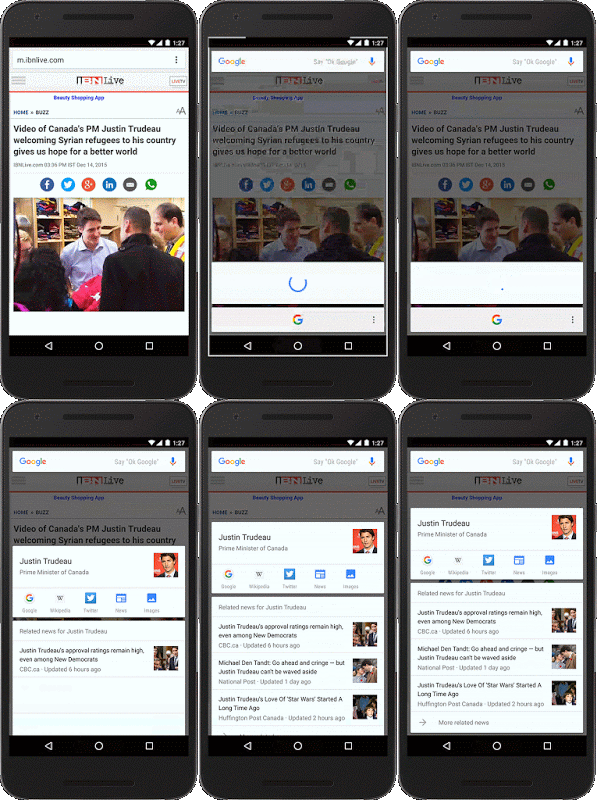
Google is expanding the capabilities of its clever mobile feature, “Google Now on Tap,” which offers additional information about what you’re looking at within a mobile application without having to exit and then perform a Google search. Before, the feature supported the ability to find restaurants and points of interest, learn more about songs or artists in music apps, get movie details and reviews, and find out more about celebs and other notable people being mentioned. Today, Google says that “Now on Tap” will also pull up flight status information, package tracking details, and surface related news articles.
The company is also introducing new sharing features and support for more languages.
In case you’re unfamiliar, “Now on Tap” was introduced earlier this year as one of the flagship features in the latest version of Android, aka Android Marshmallow. The idea with the feature is to extend Google’s search strategy on mobile by making it easier to use Google’s service without having to leave your current application.

Instead, by holding down the Home button on their device, mobile users are able to get more contextual information about what’s on their screen. That means if you were playing a song in Spotify, for example, you could press and hold the button to get more info about that song. You could also do a voice query, and ask questions like, “who is the lead singer?”
With the update, “Now on Tap” can also identify things like flight numbers and package tracking info. In practice, that will allow you to quickly check the status of a flight – like, say, right in your text messaging application where a friend just sent you their flight details – by pressing the Home button on your device.
Justin-t-not-v2
You can also press the button while in an order confirmation email to track your package’s progress – handy, especially during this busy shopping season.
Another interesting addition, and one that stands out as something that’s going a bit further than offering “context” alone is the new “related articles” function. In fact, this is almost more like an alternative to searching Google for a given topic than just a way to learn more about what you’re currently viewing. Instead, when reading an article, you can press and hold your Home button to see a list of related articles appear on the same subject. You can then navigate to a new article with just a tap.
Plus, there’s now a new share icon that will allow you to share what’s on your screen without having to exit your application.
Google says this and the other features will roll out “over the coming days.” In other words, if you’re not yet seeing these things now, you will soon.

Also worth noting: “Now on Tap” has expanded beyond English to include support for French, German, Spanish, Italian, Russian and Korean, the company says, with more languages planned for the future.
While “Now on Tap” is an interesting glimpse at the Google Search’s mobile future, unfortunately, the majority of users don’t have access to Android’s latest OS update, or “Now on Tap,” at this time. According to Google’s own data, Android Marshmallow is only installed on 0.5% of Android devices at present.


Tuesday, 15 December 2015

Apple Is Reportedly Developing Its Own, Energy-Efficient Screens For iPhone And iPad


Apple is reported to be working on its own display technology in a move that could lessen its dependence on third-party suppliers like Samsung and Sharp, and boost the battery life of its products.
Bloomberg reports that the U.S. company, which is unique for designing its own chipsfor its smartphones, is said to have opened its own secretive facility in Taiwan where it is working on screens for iPhones, iPads and other devices. (The company is advertisingfor positions at the plant.)

That could mean good news for customers who worry about the battery life of their devices. Screens tend to use a significant amount of power, but sources from the new Apple facility reportedly told Bloomberg that Apple is working to make its screens “thinner, lighter, brighter and more energy-efficient” — that means less battery strain. Indeed, those sources suggested that Apple is looking to switch to organic LEDs, which could massively save on power consumption.
You may have to wait a while for the benefits to be seen in your daily life and devices, but it appears that things are moving in the right direction at a quicker pace.


Monday, 14 December 2015

Apple names the best iOS apps of 2015


Apple on Wednesday announced its choices for the best iOS apps of 2015. Taking top honors was Periscope, an app Eddy Cue, Apple's senior vice president of Internet Software and Services, called "truly revolutionary."
hat Periscope was named app of the year for iPhone shouldn't be surprising; Meerkat may have hit the market first, but Periscope really captured the zeitgeist. It didn't hurt that Twitter acquired the small team behind the app before it even launched.
Other iPhone apps honored this year include photo editing app Enlight, stock-trading app Robinhood, the amazing productivity tool Workflow and health apps such as Lark and Fit Men Cook.
For the iPad, The Robot Factory by Tinybop was selected as iPad App of the Year. The Robot Factory is an app that lets kids build, test and collect robots. Other iPad app honorees includeHBO Now, Patterning: Drum Machine and LiquidText.
"I continue to be really impressed with the types of apps that are getting created," Cue told Mashable. "You think everything that's been created has been done and then people continue to innovate and push the envelope across all the apps."


For the editorial picks for Apple's best iOS apps of 2015, they ran the gamut. Some winners, like Periscope, originally had small teams and were acquired by bigger companies. Other apps, such as HBO Now, are truly the product of big companies, but they still managed to push the envelope in other ways. Cue cited HBO Now as one of his favorite apps of the year, just by the virtue of how much more HBO he now watches as a result.
And some apps — especially in the gaming categories — are successes that grew out of upstarts. Prune, which Apple names its Best iPad Game of the Year, is the product of one person. It's the type of game Cue loves: "Who'd think a game about trimming trees would be so beautiful and fun," Cue said. "But they've done an amazing job."

The most-downloaded apps of the year

In addition to the editorial picks, Apple also released its year-end charts of its most-downloaded apps and games of 2015. Most of the big players — Instagram, Snapchat, Facebook, YouTube — are on this list, but so are some apps you might not expect.
Crossy Road is the most downloaded free iPad app and in the top 10 of the most-downloaded iPhone apps. From Aussie-developers Hipster Whale, Crossy Road is an updated take on Frogger.
We spoke with Hipster Whale cofounder Matt Hall, one of the founders of Hipster Whale, about Crossy Road and its success in 2015 — an app that has transcended just mobile andmoved to the Apple TV.
Originally, Crossy Road was a project that cofounders Matt Hall and Andy Sum worked on as a game to do between projects. But quickly into the development process, Hall said he knew something was different and that "this could be something really special."
"We assumed failure but planned for success," Hall said. At launch, Apple featured the game as one of its best new iPhone apps of the week. And while Hall can't say how much that early exposure ultimately helped the game (we think it's the sort of game that had a viral component regardless of how it was featured), he acknowledged that being featured was "enormously helpful" and helped give the game "legitimacy."
With more than 40 million downloads for Crossy Road on iOS alone, the game has legs.

The list: Top downloads

Top free iPhone apps:
1. Trivia Crack
2. Messenger
3. Dubsmash
4. Instagram
5. Snapchat
6. YouTube
7. Facebook
8. Uber
9. Crossy Road - Endless Arcade Hopper
10. Google Maps

Top paid iPhone apps:
1. Heads Up!
2. Minecraft: Pocket Edition
3. Trivia Crack (Ad Free)
4. Five Nights at Freddy's 2
5. Facetune
6. Geometry Dash
7. Five Nights at Freddy's
8. Afterlight
9. Plague Inc.
10. Goat Simulator
Top free iPad apps:
1. Crossy Road - Endless Arcade Hopper
2. Candy Crush Soda Saga
3. Messenger
4. Netflix
5. YouTube
6. The Calculator - Free
7. Microsoft Word
8. Trivia Crack
9. Skype for iPad
10. Pinterest
Top paid iPad apps:
1. Minecraft: Pocket Edition
2. Five Nights at Freddy's 2
3. Five Nights at Freddy's
4. Geometry Dash
5. Terraria
6. Goat Simulator
7. Heads Up!
8. Five Nights at Freddy's 3
9. Toca Kitchen 2
10. Monument Valley


""

Xiaomi Launches Redmi Note Prime at Rs 8,499, Features an Upgraded SoC, Dual SIM 4G Support and Doubled up Storage


Xiaomi had us guessing last week when it teased a Prime Phone, while we guessed a Prime update for its existing line up, it seems Xiaomi had something else in its mind. Xiaomi has pulled the wraps from Redmi Note Prime, a second made in India phone that will be Priced at Rs 8,499 and will be made available exclusively on Amazon.in.


Redmi_Note_Prime
The first phone being the Redmi 2 prime, the Note Prime will be manufactured in the Sri City plant in Andhra Pradesh in collaboration with Foxconn Technology. As the nomenclature explains the Redmi Note Prime is an updated variant of the Redmi Note 4G which sold in India without an updated variant for more than a year.
The Redmi Note Prime will be powered by the Snapdragon 410 as opposed to the Snapdragon 400 in its predecessor and it will be coupled with a 2GB of RAM. The internal memory has however been bumped up from 8GB to 16GB which obviously comes with an expandable microSD card slot. Note Prime comes equipped with a 5.5-inch HD display (Still no FHD), which seems to be borrowed from its predecessor.
On the imaging front the changes are almost non existent, as it features the similar 13-Megapixel primary and 5-Megapixel secondary combo, though it is yet to ascertain if sensors have been upgraded. Xiaomi has not made any changes to the cosmetics of the phone and it looks pretty much like the Redmi Note 4G.
Another much welcomes change is the fact that unlike Redmi Note 4G the Note Prime does come with a dual SIM 4G slot. The device will be backed up by a 3100mAH battery pack and is expected to run Android Lollipop wrapped in MIUI 7. Xiaomi will be flagging off an even called“Very Mi Christmas” wherein it will launch the Redmi Note Prime along with some deals and lucky draws, the typical festival stuff! The Redmi Note Prime Sales registration will start on December 15 at 10am on Amazon.in and as a launch day offer Mi Protect will be made available at a discounted price of Rs 199.


Tuesday, 8 December 2015

Tiny baby forges adorable cross-species alliance with friendly corgi

Babies have a busy life. Many struggle with packed schedules of taking naps, watching TV, spitting up, and pushing things — including themselves— over. But babies also have important jobs as ambassadors of cuteness, so they frequently find a way to carve out some quality time for cross-species friendships.
The results are dependably adorable. Instagram user @ayako_0426 posts photos of a two-year-old Pembroke Welsh corgi and her friend, a smiley little baby. The two, it’s clear, are simply love with one another. And they do all the things best friends do: spoon each other, nap next to each other, and sometimes even smooch.
It’s a low-drama, silly, sweet friendship, the kind of relationship even adult humans aspire to. Check their beautiful little life together, below.

"Just stay there and look fluffy, please."
CorgiBabyPose

IMAGE: INSTAGRAM USER AYAKO_0426

"Watch and learn. I'm an expert."
CorgiBabyCrafts

IMAGE: INSTAGRAM USER AYAKO_0426

"The world is jealous of our love."
CorgiBabyKiss

IMAGE: INSTAGRAM USER AYAKO_0426


"You are a beautiful friend, and a wonderful pillow."
CorgiBabyHug

IMAGE: INSTAGRAM USER AYAKO_0426


"Chilling."
CorgiBabyTv

IMAGE: INSTAGRAM USER AYAKO_0426

"Just two friends, enjoying a nap."

CorgiBabyNaps


Saturday, 5 December 2015

Samsung agrees to pay $548 million to Apple for patent infringement

It all began back in 2011. Apple sued Samsung for infringing the company’s patents for things like “multi-touch gestures” and “tap to zoom” capabilities. The next year, a court ruled in Apple’s favor. Apple requested $2.5 billion in damages, but the judge decided that Samsung should pay $1,049,343,540. After an arduous legal battle that has seen many chapters, Samsung has finally agreed to pay a little over half that.

apple-vs-samsung-court-011


The final figure of $548 million was reached back in May after some protracted courtroom haggling between Samsung and Apple. Now the two companies have released a joint court statement in which Samsung has agreed to pay this amount so long as Apple can provide them with an invoice by the end of the day.
However, the term “final figure” might be a little misleading. Samsung has made it clear that they are reserving the right to reclaim the payment by reimbursement in part or in full depending on the results of any future court rulings. Apple has responded to these claims by asserting that Samsung has no such right in a legal rendition of “no takesies-backsies.”

So it looks like this is something of a false-close on this case. Sure, Samsung is agreeing to pay, but they’re everything but giving up on this. The company is expected to pursue a US Supreme Court review of the patent infringement case, and many are contesting whether or not the patents sought by Apple should have ever been awarded in the first place. If the US Supreme Court agrees to hear the case, we might be looking at a retrial.


Thursday, 3 December 2015

Google’s November Self-Driving Car Report Details Learnings, A Pull-Over, And A Rear-End Collision


Google’s monthly self-driving car reports are fun to read through, and gives transparent accounts of what the team is up to, how the cars are performing, and any lessons learned along the way. Last month focused on pedestrians with Halloween being a helper.
This month? The company says its currently averaging 10,000-15,000 autonomous miles per week on public streets with 23 Lexus RX450h SUVs and 30 prototypes on the road. We also learned more about that car that was going too slow and got pulled over, as well as one of the cars being rear-ended at a red light.
On the former, Google explains why their cars were going so damn slow:
From the very beginning we designed our prototypes for learning; we wanted to see what it would really take to design, build, and operate a fully self-driving vehicle — something that had never existed in the world before. This informed our early thinking in a couple of ways. First, slower speeds were easier for our development process. A simpler vehicle enabled us to focus on the things we really wanted to study, like the placement of our sensors and the performance of our self-driving software. Secondly, we cared a lot about the approachability of the vehicle; slow speeds are generally safer (the kinetic energy of a vehicle moving at 35mph is twice that of one moving at 25mph) and help the vehicles feel at home on neighborhood streets.

The Mountain View police now knows why Google’s cars are driving around at that speed…and so do we.
Screen Shot 2015-12-01 at 3.41.05 PMOn the rear-end accident, ​one of Google’s Lexus model autonomous vehicles or “Google AV” was hit from behind by a car going 4 MPH while the Google AV waited to take a right at a red light. The car that hit it rolled after its stop, thus hitting the car. Nobody was hurt. The team went on to explain how it trains its software to handle situations such as knowing when it’s OK to turn right on red:
Our vehicles can identify situations where making a right turn on red is permissible and the position of our sensors gives us good visibility of left-hand traffic. After coming to a complete stop, we nudge forward if we need to get a better view (for example, if there’s a truck or bus blocking our line of sight). Our software and sensors are good at tracking multiple objects and calculating the speed of oncoming vehicles, enabling us to judge when there’s a big enough gap to safely make the turn. And because our sensors are designed to see 360 degrees around the car, we’re on the lookout for pedestrians stepping off curbs or cyclists approaching from behind.
It’s all fascinating stuff. It’s like teaching a kid how to drive for the first time, except this kid is a big damn car driving itself around. Google feeds its software with all types of data, collecting more and more information as the cars drive the streets.


Tuesday, 1 December 2015

See Serena Williams and Amy Schumer's stunning nude portraits shot by Annie Leibovitz

Amy Schumer got naked on camera the best way Amy knows how to — with an honest sense of humor.
The comedian posed topless for Pirelli's 2016 Calendar, shot by Annie Leibovitz. She posted the image to Twitter with this frank caption: "Beautiful, gross, strong, thin, fat, pretty, ugly, sexy, disgusting, flawless, woman."
Amy-schumer-pirelli

Leibovitz, who said in a press release she is a "great admirer of comediennes," elaborated on Amy's picture: "The Amy Schumer portrait added some fun. It’s as if she didn’t get the memo saying that she could keep her clothes on.”
In a behind-the-scenes video, Schumer described her experiences during the photoshoot: "I felt I looked more beautiful than I've ever felt in my life, and I felt like it looked like me."
The 43rd edition of "The Cal," distributed to VIPs and Pirelli clients, departed from its standard scantily clad top models this year. Leibovitz, who previously shot for Pirelli in 2000 (photographing nude ballerinas), instead focused on diverse, powerful and trailblazing women who looked "strong but natural," Leibovitz said in a previously released statement.
"The idea was not to have any pretense in these pictures and be very straightforward," she said.

Apart from Schumer, the calendar also features black-and-white simple studio photographs of Ava DuVernay, Tavi Gevinson, Patti Smith, Yao Chen, Fran Lebowitz, Yoko Ono and Serena Williams, among others.
pirelli calendar serena williams

pirelli calendar patti smith

pirelli calendar yao chen


pirelli calendar amy schumer